Industry playbook + project · Free to use
Electronics ecommerce SEO playbook
Keep model, condition, compatibility and bundle differences visible from search result to product page.
Practice datasets are fictional and labeled as such. Real store captures are dated observations with their own sources and evidence limits.
Identify the exact offer before comparing it
Select one product family and collect manufacturer model numbers, retailer SKUs, condition, region, included accessories, specifications and support documents. The output is an offer comparison and compatibility record. A shared marketing name does not prove two offers are equivalent.
Use public retail pages to inspect how information is presented, then validate factual specifications against the manufacturer or an authorized product source for your own store. A retailer’s promotional claim is not independent test evidence. Keep measured specifications, manufacturer claims and customer opinions distinct.
Real store observation
Best Buy: turn specifications into a comparison
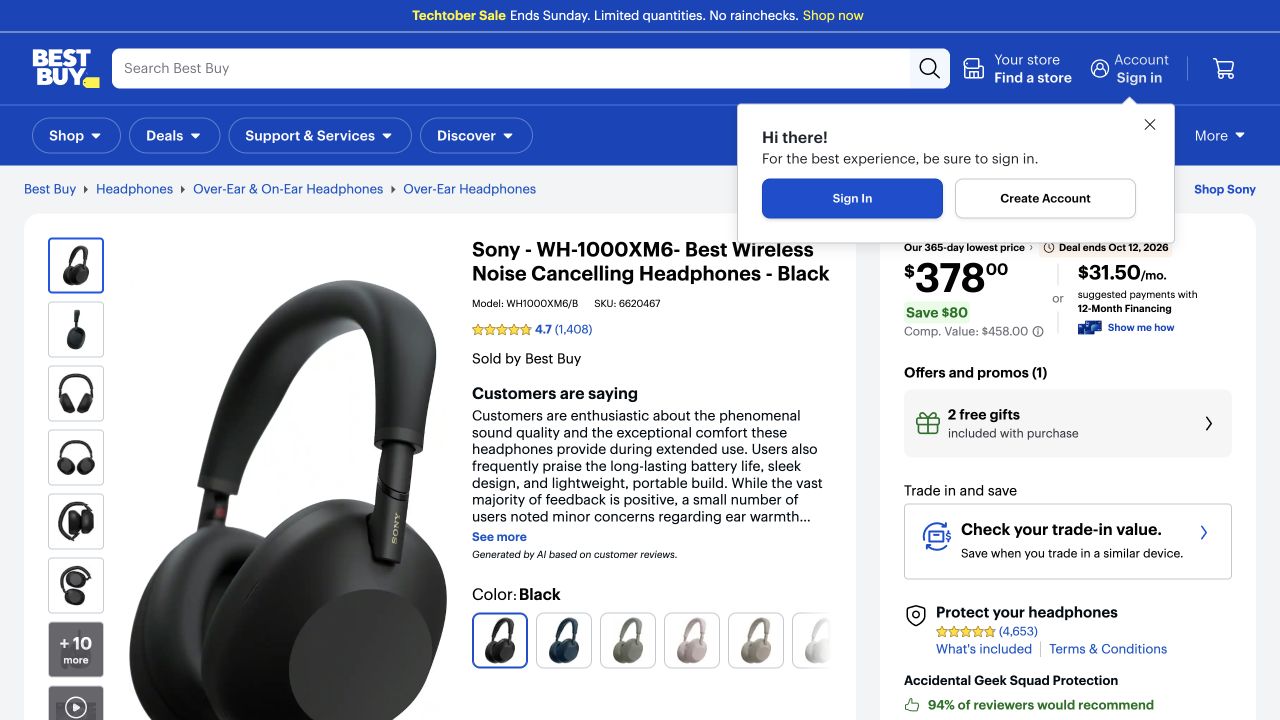
- The manufacturer model and retailer SKU are different identifiers.
- Color and seller context matter when matching the offer elsewhere.
- A product name alone is not sufficient to compare bundles or refurbished units.
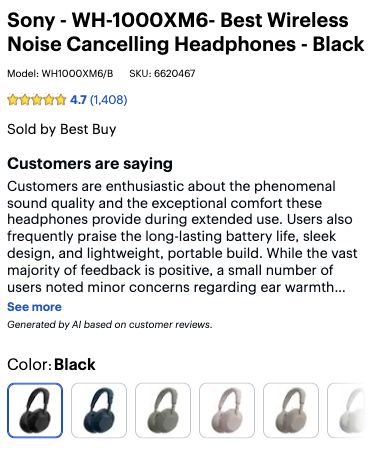
- Model and SKU are visible together.
- Black is the selected color.
- The seller is Best Buy; the AI review summary is not manufacturer specification evidence.
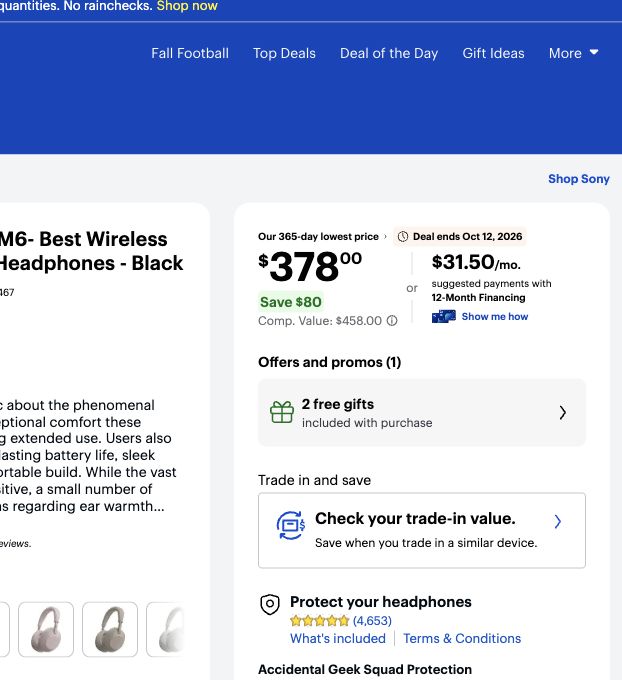
- Connection type and True Wireless describe different properties; they should not be collapsed into one ambiguous “wireless” claim.
- Units make a specification usable for comparison; preserve them when building a table.
- These are retailer-displayed specifications, not measurements performed by this course.
Independent educational analysis of Best Buy’s public page. No client relationship or endorsement is implied.
Evidence limits. The course did not test the headphones or verify manufacturer performance claims. Prices, ratings and delivery estimates are capture-time context, not current purchasing advice.
Real store observation
Google Shopping: from search result to the exact offer
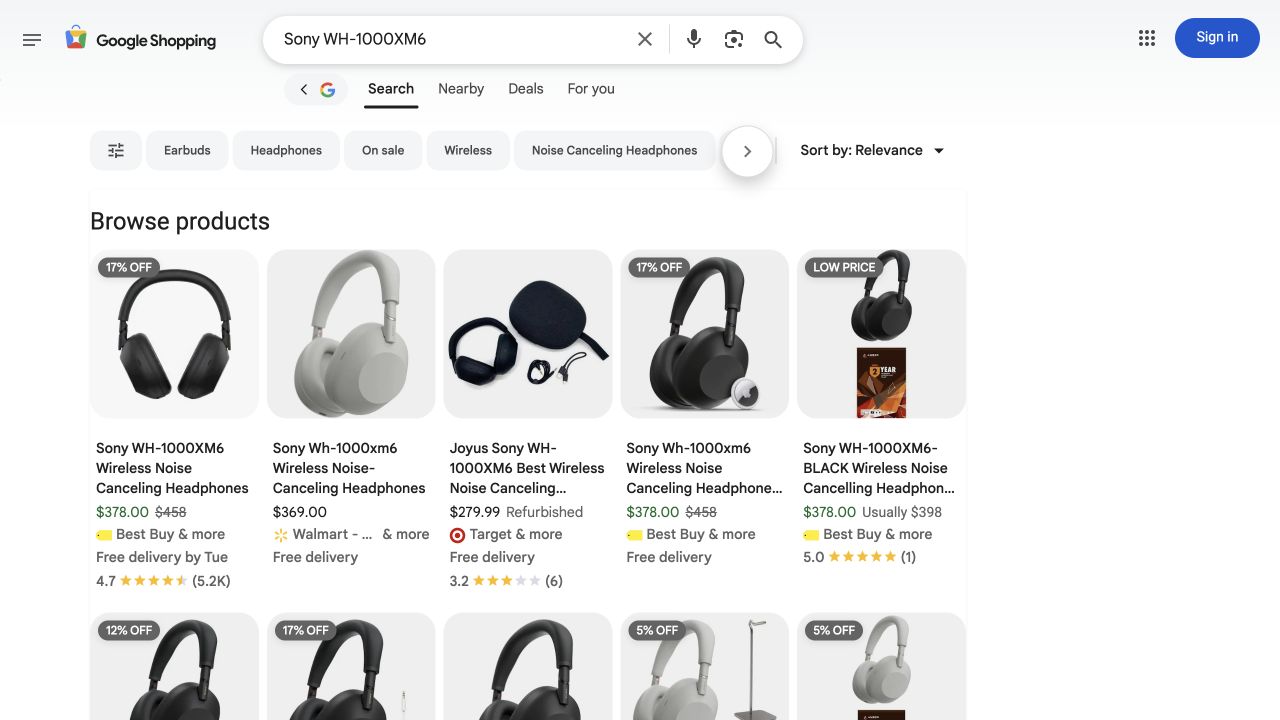
- The query is visible so the result can be interpreted in context.
- Some cards represent refurbished offers or bundles; prices are not automatically equivalent.
- No Sponsored label was visible in this captured area. This is not an audit of every placement on the page.
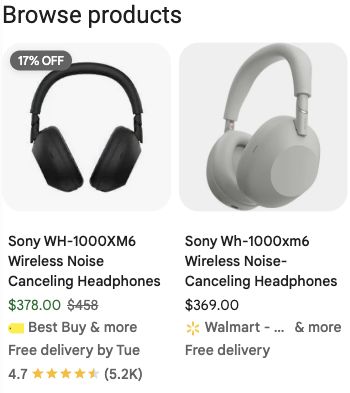
- Title, seller and price identify the offer the shopper is about to investigate.
- Delivery claims depend on context and time; they must be checked again at the retailer.
- The title is only one part of the offer. Rewriting it cannot repair a wrong landing variant.
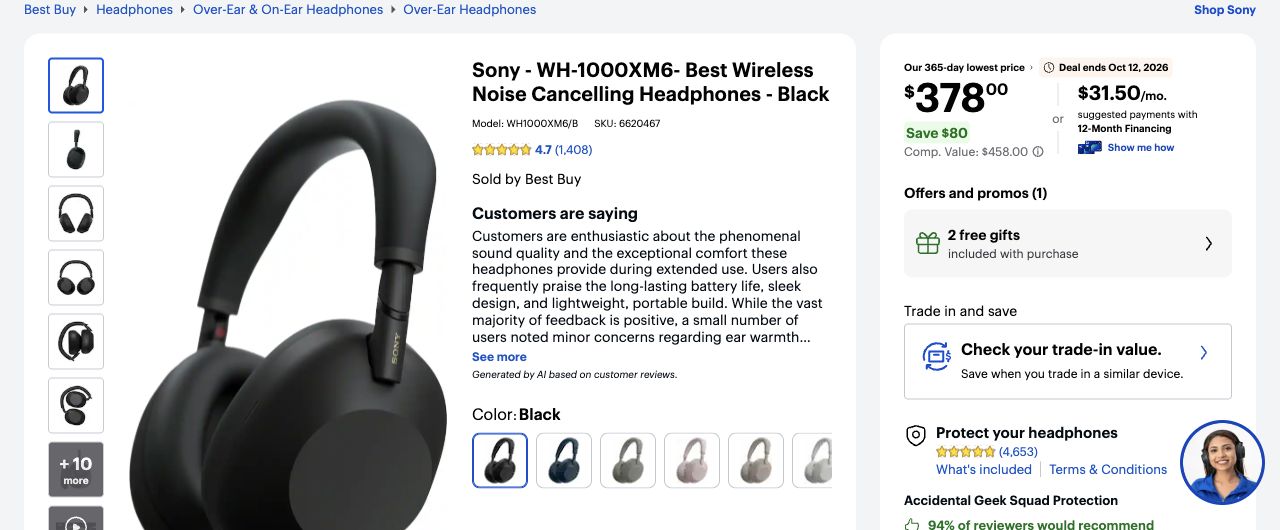
- The link landed on the black WH-1000XM6 with model WH1000XM6/B and SKU 6620467.
- The observed Shopping price and retailer offer were $378 in this session.
- Compare condition, selected color and delivery again; a matching model name is not the whole verification.
- Model and SKU are visible together.
- Black is the selected color.
- The seller is Best Buy; the AI review summary is not manufacturer specification evidence.
Independent educational analysis of Google Shopping / Best Buy’s public page. No client relationship or endorsement is implied.
Evidence limits. Signed-out session with gl=us and hl=en; precise location unknown. Results change by time, location and context. No private Merchant Center data, paid campaign settings or conversion performance was accessed.
Build the comparison around identity and condition
Match model, capacity, region and condition before comparing price. A refurbished item, import model or bundle can legitimately differ from a new domestic unit. Include those differences in the visible title or offer description where they are needed to avoid a misleading comparison.
Keep retailer SKU and manufacturer model in separate columns. Do not invent manufacturer identifiers from the store’s internal ID. Stable IDs help reconcile feeds and inventory, while readable model details help the customer check that they have selected the intended generation.
| Offer | Model and condition | Comparable? |
|---|---|---|
| A | Model X; new; domestic warranty | Baseline |
| B | Model X; refurbished | Different condition; label separately |
| C | Model X plus charger bundle | Different inclusions; compare the bundle value explicitly |
| D | Model X previous generation | Different product; explain compatibility and feature changes |
Translate specifications into buying decisions
Organize attributes that resolve real constraints: connection type, supported interfaces, dimensions, power requirements and included parts. Keep units consistent and link to fuller documentation. “Wireless” can describe a connection while another technical classification, such as true wireless, has a different meaning; explain the distinction rather than hiding apparently conflicting fields.
For compatibility, state the exact tested or documented relationship. A connector that physically fits is not proof that charging power, data mode or protocol is supported. Ask for manufacturer compatibility evidence before adding “works with all” language. Use a comparison table only when values describe equivalent test conditions.
Handle successors and support value
When a model is replaced, decide whether manuals, firmware links or accessory compatibility keep the old page useful. A newer generation may not satisfy the same requirement. Do not redirect every old model automatically just because its replacement has a higher model number.
If a successor is recommended, disclose the differences that matter: dimensions, connector changes, included accessories and compatibility. Maintain support routes for existing owners when needed. Keep unavailable offers out of misleading shopping promotions while preserving accurate reference information.
Worked project: headphones across Shopping and retail
The captured Shopping query presents the Sony WH-1000XM6 name across sellers, colors, refurbished offers and bundles. The Best Buy page separately exposes a model number, seller, color and specification panel. These observations show which identity fields a comparison needs; they do not establish that every result is the same offer.
For the fictional workbook, compare a new black domestic unit with a refurbished unit and a charger bundle. Record condition and inclusions before calculating any price difference. If warranty scope is unknown, mark it unknown and identify the evidence required rather than assuming equivalence.
Acceptance and verification
Practice: two listings use the same product photo and name, but one is an international model. Write a comparison sentence and a verification request. Worked answer: identify the regional variant and ask for warranty, plug and compatibility documentation. Do not describe the cheaper listing as equivalent until those details are confirmed.
Pass when a reader can distinguish the offers without relying on the photograph, every compatibility claim has evidence and the feed lands on the intended model and condition. Recheck after supplier imports and model refreshes. Measure relevant search and product-selection behavior without attributing performance to the presence of a famous brand screenshot.
Sources and maintenance
Check current platform documentation before implementation. Review these instructions when your platform, catalog behavior or source guidance changes.